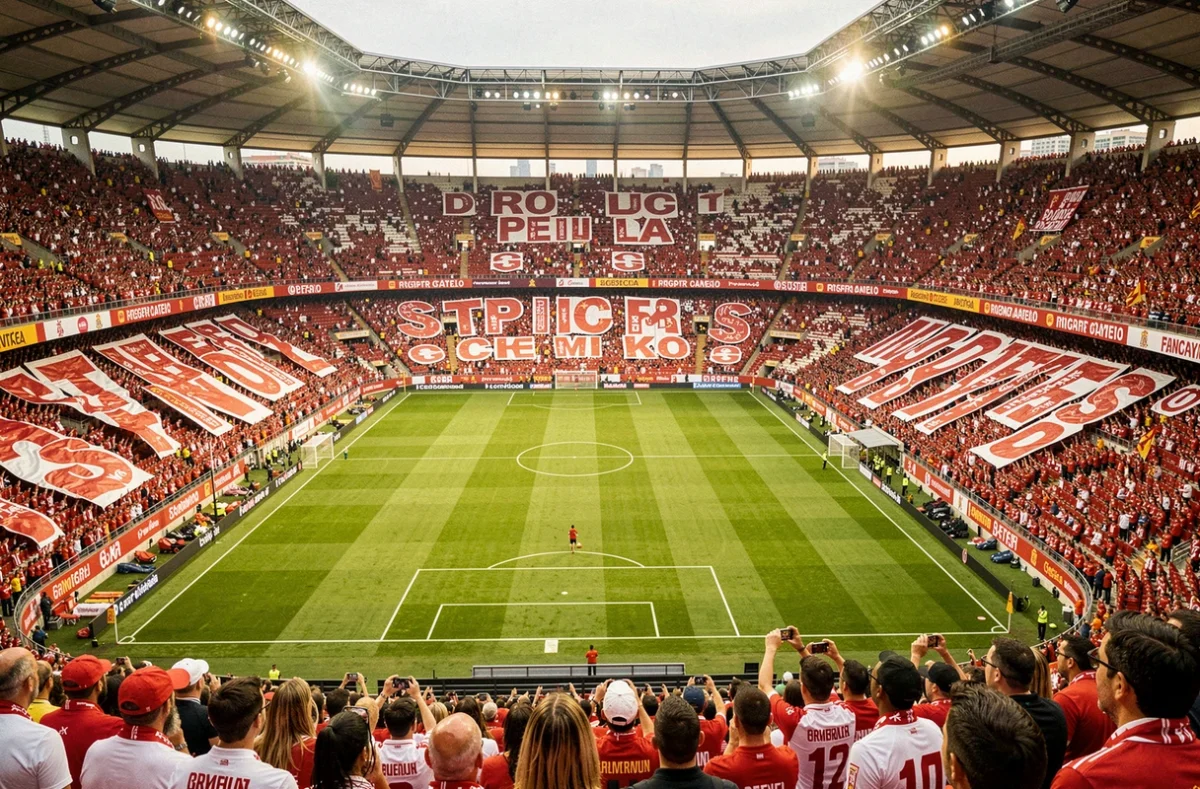
When a Spanish football fan checks the Liga fixture list, they may find their team scheduled to play on a Monday at 9 p.m. or on a Sunday at 2 p.m. in the height of summer. This seemingly minor detail sums up a reality of the Spanish league: you can’t understand La Liga solely through its trophies or top scorers, but also through the economic and regulatory mechanisms that have shaped every season since its founding on February 10, 1929.
TV kick-off times and attendance in La Liga: what changes the matchday experience
Since the centralised sale of audiovisual rights was introduced in 2015, La Liga has spread its matches across as many different kick-off slots as possible. The goal is clear: to offer Spanish football around the clock and increase international TV revenue.
This strategy has a direct impact on the stands. Staggered kick-off times make it harder for fans to travel, especially for matches scheduled in the early afternoon at weekends or on weekday evenings. Season-ticket holders at smaller clubs, which rely more heavily on local fans, feel the impact more than supporters of the big clubs, whose stadiums also draw tourists.
Official LaLiga figures show that total attendance increased between the 2023-2024 and 2024-2025 seasons. The league does, however, qualify this figure: construction work at several stadiums and FC Barcelona’s change of venue make it difficult to interpret the increase at face value. It therefore cannot be seen as a simple resurgence in popularity without taking these structural factors into account.
Centralised sales have also narrowed the gap in audiovisual revenue between clubs compared with the old system of individual negotiations. Real Madrid and FC Barcelona still receive a significant share of the revenue, but mid-table clubs have gained greater visibility and higher revenues than under the previous system. To explore La Liga statistics in detail, several databases compile these economic and sporting trends season by season.

Squad cost limit: the financial controls shaping transfers in La Liga
La Liga applies a financial regulation mechanism that is often misunderstood abroad. Unlike systems that penalise clubs after they exceed their budgets, the Spanish system intervenes before players can be registered. Each club is assigned a squad cost limit calculated from its projected budget.
If a club exceeds this limit, it simply cannot register a newly signed player, even if the contract has already been signed. In recent seasons, there have been cases where new signings had to wait several weeks before they could play while their club freed up room in its wage bill.
What the limit actually includes
The term “salary cap” is misleading. The limit set by LaLiga covers several costs:
- The annual amortisation of transfer fees, not just the amount paid in the first year
- Social security contributions and contractual bonuses paid to players
- Certain benefits in kind (housing, car) counted as remuneration
This approach explains why the true cost of signing a player is far higher than the announced transfer fee. A player signed for a modest fee but given a high salary and substantial bonuses can count more towards the limit than an expensive transfer amortised over five years.
For La Liga clubs without the commercial revenues of Real Madrid or Barcelona, this system forces them to make concrete sporting trade-offs: prioritise loan deals, sign players whose contracts are expiring, or invest in their own academy.
Records and the historic dominance of the Spanish league
Since 1929, La Liga titles have been won by a small number of clubs. Real Madrid tops the honours list with the most titles, followed by FC Barcelona. Atlético Madrid, Athletic Bilbao and a handful of other clubs complete the list of champions, but the concentration of titles remains among the highest of Europe’s major leagues.
Goalscorers and appearances: the key statistics
These figures reflect the league’s tactical and economic realities. Clubs able to keep their best players over the long term rack up individual records. The stability of the squads at Real Madrid and Barcelona, backed by budgets unmatched in La Liga, has helped drive these historic achievements.

La Liga and player development: Spain’s talent pool beyond the two giants
La Liga is often reduced to the Real Madrid–Barcelona rivalry, but Spanish football develops players at every level. Clubs such as Real Sociedad, Villarreal and Athletic Bilbao (which recruits exclusively Basque players or those developed in the Basque Country) operate with very different sporting models.
Athletic Bilbao follows a restrictive recruitment policy, yet remains competitive season after season. It has never been relegated in nearly a century of existence, despite its deliberately limited recruitment pool.
This diversity of models, combined with strict financial controls, encourages Spanish clubs to invest heavily in their academies. The results are evident in the national team: most Spain players came through La Liga academies before making their mark on the international stage.
La Liga remains a league where regulatory and television constraints carry as much weight as on-field talent. Understanding its records means looking at the economic rules that make them possible, as well as those that prevent some clubs from competing despite remarkable seasons.