
Finding a healthcare professional online involves distinguishing between several types of digital intermediaries. Appointment booking platforms, teleconsultation sites, institutional directories: each applies its own criteria for listing practitioners, and these criteria do not all guarantee the same level of verification.
Verification of diplomas and listing: what happens behind the scenes
When a practitioner appears on an appointment or teleconsultation platform, patients often assume that their qualifications have been checked. The reality varies depending on the type of platform.
Public directories, such as that of the Order of Physicians or the ADELI directory, verify the regulatory registration of the professional. A doctor, physiotherapist, or nurse is only listed after validation of their diploma by the competent authority. For a patient, cross-referencing a name with an institutional directory remains the most reliable check.
Private appointment booking platforms also conduct checks, but their processes are not uniform. Some require an RPPS or ADELI number upon registration, while others are satisfied with a declaration. For practitioners of complementary medicine (osteopaths, naturopaths, sophrologists), the framework is even more unclear: the lack of title protection for certain disciplines complicates any automated verification.
Consulting the professionals on Dr Hackney net allows you to identify practitioners whose skills are categorized by specialty, which facilitates the initial sorting before verifying official registrations.
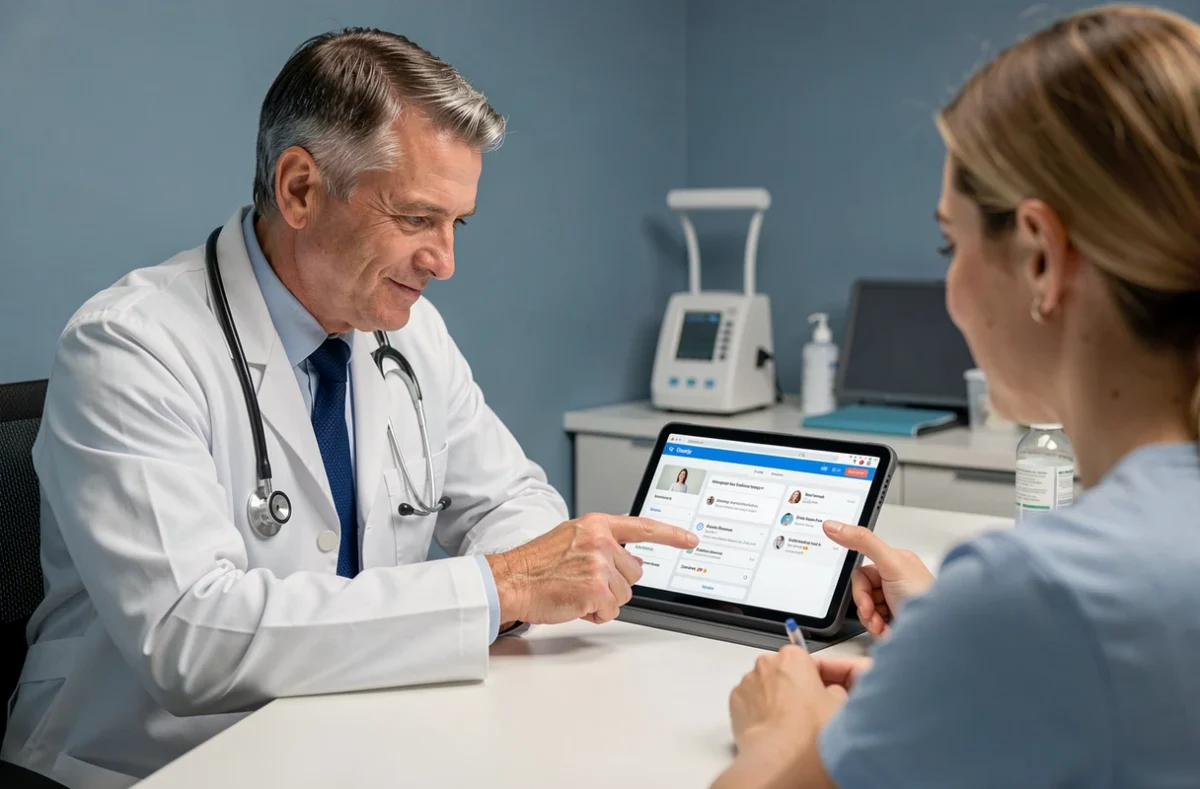
Private teleconsultation: selection criteria beyond availability
Private teleconsultation companies (Livi, Qare, Medadom, among others) have taken a considerable place in access to remote care. According to data from the Ministry of Health reported by e-sante and 60 Millions de consommateurs, these platforms accounted for about 40% of reimbursed teleconsultations in 2024, compared to 6% in 2021.
This rapid growth means that many patients choose a practitioner through these services without going through their primary care physician. The main criterion becomes the speed of availability, not the trust-based relationship built over time.
To evaluate the reliability of a teleconsultation platform, several points deserve attention:
- Is the proposed practitioner registered with the Order or in the RPPS directory, and is this information accessible before the consultation?
- Does the platform specify the exact specialty of the doctor, or does it simply offer “an available doctor” without distinction?
- Are the health data exchanged hosted by a certified HDS (Health Data Hosting) provider, in accordance with French regulations?
- Does the displayed fee correspond to the regulated fee, or does the platform charge a premium for faster access?
This last point has been the subject of recent alerts. Some platforms offer priority access for an additional fee, which amounts to conditioning the speed of care on the payment of an unreimbursed surcharge.
Dominant position of Doctolib and free choice of practitioner
The market for online medical appointment booking in France is largely concentrated. Doctolib holds an almost monopolistic position in this segment. This dominance has concrete consequences on how patients find a healthcare professional.
A practitioner absent from Doctolib becomes, in fact, less visible to the majority of patients who use this platform as their sole entry point. The listing on the platform partly depends on the package subscribed to by the professional, which means that the visibility of a practitioner does not necessarily reflect their competence.
To circumvent this bias, it is useful to diversify research sources. Professional order directories, multi-professional health center websites, and CPTS (Territorial Professional Health Communities) directories list practitioners based on geographic and specialty criteria, without commercial logic.
Patient reviews online: what they really measure
Reviews posted on appointment platforms or on Google primarily evaluate the relational experience: waiting time, listening, friendliness. These elements matter, but they say nothing about the relevance of a diagnosis or the quality of treatment.
A practitioner who takes the time to explain will receive good ratings. A practitioner who makes an uncomfortable diagnosis or refuses an unjustified prescription risks a negative review. Reviews measure satisfaction, not clinical competence.
Medical ethics strictly regulates the solicitation of reviews by healthcare professionals. A doctor cannot actively ask their patients to leave a positive comment. Profiles with a very high volume of glowing reviews without any nuance deserve critical reading.

Medical ethics and online advertising: the legal framework to know
The medical code of ethics prohibits commercial advertising for doctors, dentists, and midwives. A practitioner can inform the public about their skills and activity but cannot resort to promotional methods.
In practice, the line between information and advertising blurs on social media. Some healthcare professionals publish content that resembles marketing, particularly in aesthetic dermatology or surgery. Recent regulatory projects aim to more strictly regulate advertising in the fields of optics and hearing, reflecting increased vigilance from authorities.
For the patient, a practitioner profile that highlights spectacular results, identifiable patient testimonials, or promotional offers should raise alarms. A healthcare professional who respects ethics informs without seeking to seduce.
Cross-referencing remains the most solid method: verifying the ordinal registration, consulting multiple sources, and distinguishing what pertains to commercial visibility from what pertains to professional qualification. A practitioner who is hard to find online is not necessarily less competent than a practitioner who is omnipresent on platforms.